It is nearly 11 p.m. Your laptop screen is glowing, and the paper you need to submit tomorrow is still on its first page. For hours, you have been meaning to start. You even know that if you do not start now, you will be under even more pressure tomorrow. Your hand moves toward the mouse, but before you can type the first sentence, a simple thought crosses your mind: “I’ll just take a five-minute break, then I’ll start.”
Five minutes turn into half an hour—a short video, a quick scroll through social media—and suddenly you realize that time has passed, yet the task remains untouched. For a moment, you ask yourself: “I knew this was important, so why didn’t I do it?”
This paradox lies at the core of procrastination: the brain may sometimes choose immediate relief from an unpleasant emotional state, even when that choice makes the future more difficult. The question is: what happens within the hidden interplay of brain networks during this struggle?
Procrastination: A Problem of Emotion, Not Time
Contrary to popular belief, procrastination is not synonymous with laziness. Nor is it simply a lack of motivation or interest. In procrastination, individuals postpone a task despite recognizing its importance and the negative consequences of delay—and may even experience distress because of that postponement [1].
Contemporary research conceptualizes procrastination as a form of self-regulation failure: a difficulty in aligning present behavior with a goal that is valuable for the future [1].
A demanding task is not merely a sequence of logical steps. It may also evoke fear of failure, uncertainty, or perfectionistic concerns. Under these conditions, the brain must weigh the value of a future reward against the immediate affective cost of engaging in the task [1, 2].
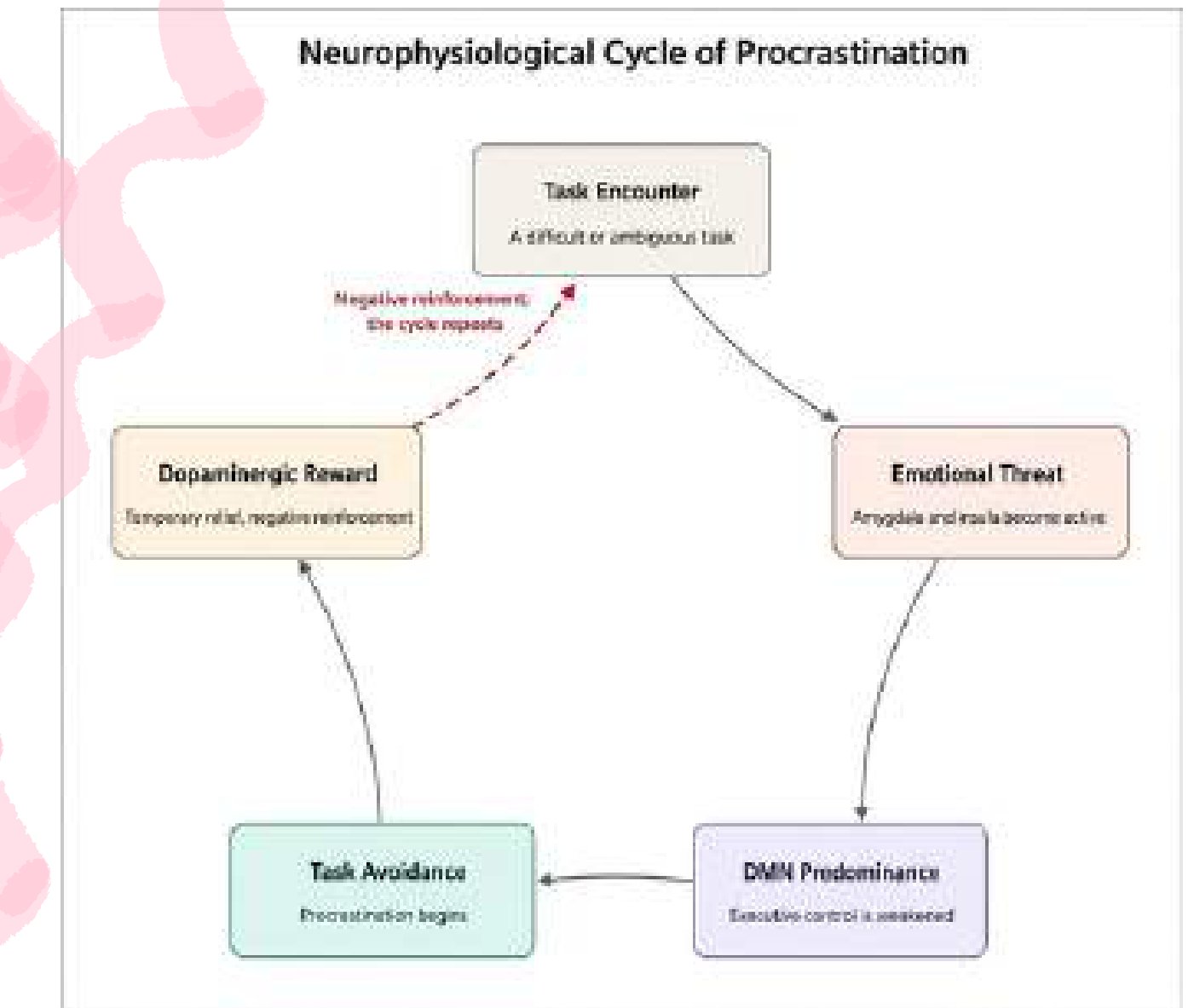
If initiating the task evokes anxiety, avoiding it can produce an immediate reduction in psychological distress. This process is known as negative reinforcement: a behavior becomes more likely to recur because it reduces or removes an aversive state, such as anxiety, fear, or psychological distress.
The Battle Between Neural Circuits: Immediate Reward vs. the Distant Future
One important contributor to procrastination is the way the brain evaluates outcomes across time. Immediate rewards are generally weighted more heavily than delayed rewards—a phenomenon known as temporal discounting, in which the subjective value of an outcome decreases as the delay to that outcome increases [1, 3].
This helps explain why the statement “I’ll start tomorrow” can seem entirely reasonable in the moment. The mind postpones the demanding task to a future point at which it imagines having more energy and experiencing less stress [2].
Three major neurocognitive systems are particularly relevant to this conflict:
- Executive control network (ECN), particularly the prefrontal cortex:
- This system helps keep goal representations active and resist distraction from competing stimuli [4, 5].
- Emotion- and salience-processing systems, including the amygdala and insula:
- In individuals prone to procrastination, task initiation may be processed as emotionally threatening. Neuroimaging studies suggest that functional connectivity between prefrontal regions and the insula is associated with emotion-regulation capacity and lower levels of procrastination [4].
- Reward and dopaminergic systems:
- Dopamine is not simply a “pleasure chemical.” Dopaminergic signaling contributes to reward learning, motivation, and behavioral value updating. When task avoidance produces temporary relief, that relief can function as a reinforcing outcome, increasing the likelihood that avoidance will be repeated in the future (Figure 1) [1, 2].
From “Thinking” to “Doing”
The Prison of Thought: When the Brain Remains Stuck in the “Thinking” Stage
Sometimes the problem is not that we are unaware of the consequences of postponing a task. Rather, the difficulty lies in the transition from intention to action.
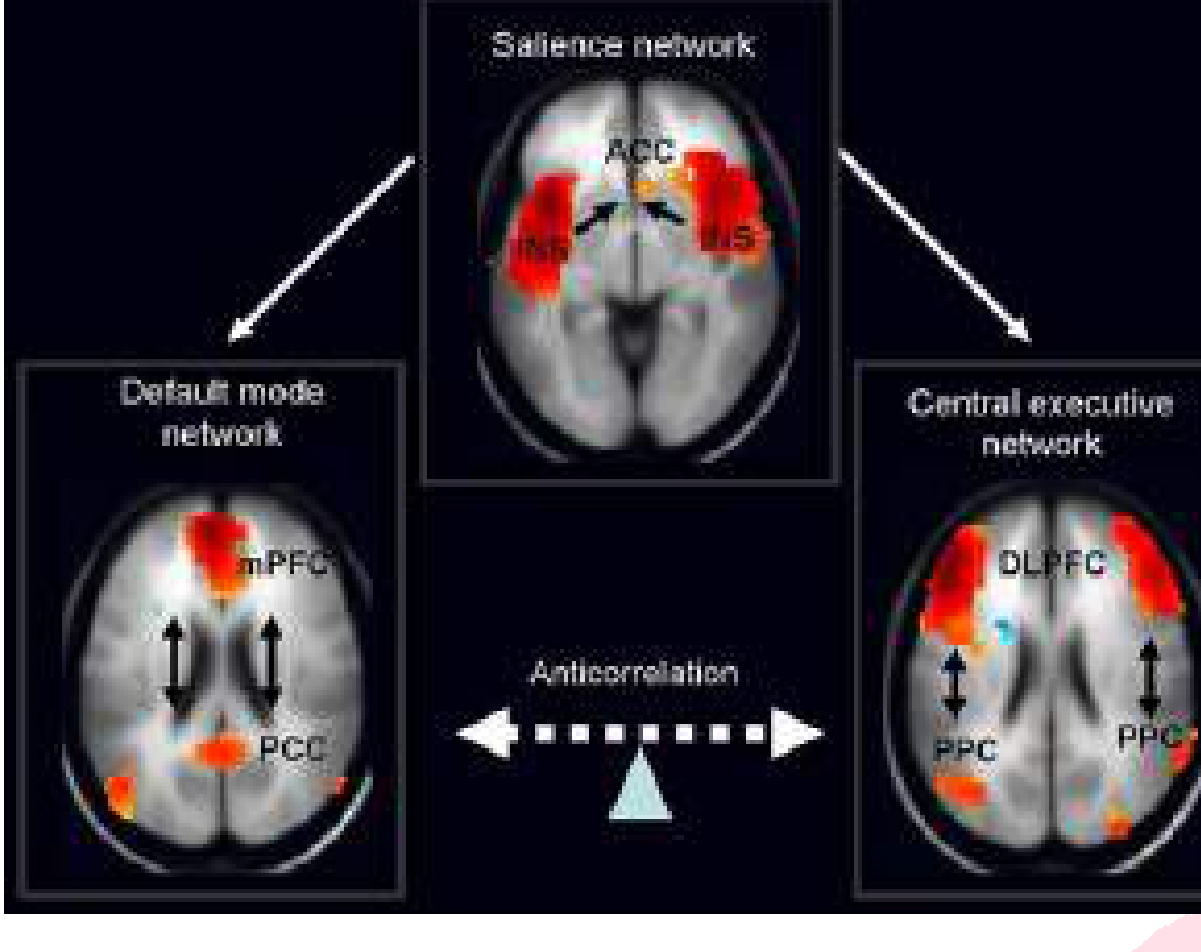
This is where the default mode network (DMN) becomes relevant. The DMN is naturally more active when attention is directed inward—for example, during mind-wandering, daydreaming, self-referential thought, or the mental review of personal concerns.
In individuals prone to procrastination, coordination between large-scale brain networks may become less efficient. fMRI studies suggest that executive networks involved in goal-directed control may be less effective at regulating internally oriented processing associated with the DMN. As a result, the individual may remain engaged in repetitive thoughts, imagined scenarios, and internal analyses surrounding the task, without successfully moving from the world of thought into goal-directed action. (Figure 2).
Difficulty switching between internally oriented thought and goal-directed behavior may become particularly pronounced in certain clinical conditions and psychological traits:
- In ADHD: impaired attentional and executive control may make it more difficult to maintain goal-directed behavior in the presence of competing stimuli, causing attention to repeatedly drift away from the intended task.
- In perfectionism: internally generated thoughts may become dominated by self-criticism and fear of an imperfect outcome. Task initiation can therefore be appraised as highly threatening, leaving the individual trapped in hesitation rather than action [1, 2].
Which Procrastination Pattern Do You Most Often Show?
A practical framework discussed by Neuroscience News in relation to Itamar Shatz’s book Solving Procrastination describes nine procrastination patterns [6]. Each pattern reflects a different psychological trigger that may become active before a task is postponed. Three commonly recognizable examples are described below.
A perfectionistic procrastinator may stare at the same paragraph for hours, delete it, rewrite it, and delete it again—not because they do not know what to write, but because no version seems “good enough.” The brain evaluates beginning the task not as a simple first step, but almost as a final examination of competence.
A worried procrastinator may mentally rehearse numerous failure scenarios before writing even a single sentence. “What if it gets rejected?” becomes so dominant that the individual postpones action because of catastrophic thinking.
A zigzag procrastinator sits down at the desk, opens a browser tab to check “just one source,” and half an hour later is reading something entirely unrelated. Each new stimulus pulls attention away from the primary task.
The remaining six patterns follow a similar logic but involve different triggers. The Pessimist anticipates that the outcome will be pointless before even beginning. The Dreamer becomes so absorbed in imagining the outcome that the first concrete step is never taken. The Rebel experiences the task as externally imposed and resists it.
A Brief Exercise: Which Pattern Feels Most Familiar?
| Pattern | Statement Closest to Your Experience |
|---|---|
| Worrier | “What if the outcome is bad?” So, for now, I do not start. |
| Pessimist | “There is no point.” So I postpone the effort. |
| Perfectionist | “I’m not ready to do it perfectly yet.” |
| Dreamer | I think about the task a great deal, but I do not take the first step. |
| Zigzagger | Every new message or stimulus pulls me away from the main task. |
| Rebel | Because the task feels imposed on me, I resist doing it. |
| Thrill-seeker | Only the pressure of an approaching deadline gets me moving. |
| Hedonist | I choose the easier and more enjoyable option available right now. |
| Burnout | Almost every task feels as though it requires too much energy. |
The Thrill-seeker becomes motivated only when the deadline is imminent. The Hedonist chooses the easier and more immediately rewarding option over sustained long-term effort. Finally, the Burnout procrastinator experiences even relatively simple tasks as requiring more energy than is readily available.
These nine patterns are not clinical diagnoses or neurophysiological classifications. Rather, they provide a simple framework for identifying the trigger that tends to become active immediately before procrastination occurs. The rule of this exercise is simple: choose only one or two statements that resemble your experience most closely, and then ask yourself: “What am I trying to escape from in this moment—fear, uncertainty, boredom, or exhaustion?”
The answer is not a clinical diagnosis. It is simply a clue that may help identify where the first effective step toward action should begin.
A behavior that appears identical on the surface may arise from very different triggers: fear and catastrophizing in the Worrier, expectations of failure in the Pessimist, fear of an imperfect outcome in the Perfectionist, attentional shifting and distractibility in the Zigzagger, or a preference for immediate reward in the Hedonist.
This interpretation is broadly consistent with research implicating task aversiveness, emotion regulation, impulsivity, and temporal discounting in procrastination. However, these labels themselves should not be interpreted as established clinical categories [1, 2].
From this perspective, the solution is unlikely to be identical for everyone. For the Perfectionist, defining an “acceptable version” rather than a “perfect version” may be particularly important. For the Zigzagger, reducing competing stimuli and translating vague goals into concrete steps may be more useful. For the Worrier, identifying catastrophic predictions may be the critical first step. For the Burnout procrastinator, it is important to distinguish task avoidance from a genuine limitation caused by fatigue.
This framework is intended for self-reflection, not self-diagnosis [6].
Breaking the Cycle: Building Your Future Brain
One crucial principle is that the brain is not static. Through neuroplasticity, experience can modify patterns of neural activity and connectivity. Just as repeated avoidance can establish familiar behavioral patterns, new experiences can support alternative patterns of responding.
Reducing the size of the first step—for example, “I’ll work on it for only five minutes”—may alter threat-related predictions associated with task initiation. Once the task has begun, the anticipated cost of performing it may decrease as direct experience replaces the anxiety-provoking representation imagined beforehand [2, 3].
Procrastination is not the story of a lazy brain. It is the story of a brain caught between two competing worlds: immediate reward and long-term goals. Each time we take even a small step despite discomfort, we begin to shift the balance of that competition. We are not merely products of our brain activity; our experiences also shape the brain itself. Perhaps this is one of the most important lessons of neuroscience: our brains have been shaped by our past, but with every new choice, we participate in reshaping neural connections and building the brain of our future.
References
- Steel P. (2007). The nature of procrastination: a meta-analytic and theoretical review. Psychological Bulletin, 133(1), 65–94.
- Sirois FM, & Pychyl TA. (2013). Procrastination and the priority of short-term mood regulation. Social and Personality Psychology Compass, 7(2), 115–127.
- Zhang P, & Ma WJ. (2024). Temporal discounting predicts procrastination in the real world. Sci Rep 14, 14642, 2024.
- Li K, Zhang R, Feng T. (2024). Functional connectivity in procrastination and emotion regulation. Brain and Cognition, 182, 106240.
- Zhang W, et al. (2016). Identifying the neural substrates of procrastination: a resting-state fMRI study. Scientific Reports, 6, 33203.
- Neuroscience News. (2026). Study Maps the 9 Distinct Types of Procrastinators. (Based on I. Shatz research).