Why Does the Brain Move Toward Another’s Pain in a Crisis, Rather Than Flee?
In the heart of every large-scale crisis—where safety and peace are snatched from people’s lives in the blink of an eye—two groups of reactions always emerge side by side. Some, though caught in the very same danger, move without a moment’s hesitation toward the voice they hear through the chaos, to offer help. Others, in that same moment, hear that very same voice, but their feet carry them in the opposite direction. Both are human; both stand in the same moment of peril—but their brains have taken two entirely different paths. Why does one stay while the other leaves? The answer lies in four brief stops within the brain—a pathway that neuroscience has recently mapped with increasing precision.
Brain Stations
Stop One: The body reacts before the mind
The first thing that happens in the brain of that helping individual—even before they realize they are making a decision—is an almost automatic reflex. Mirror neurons, a group of nerve cells in the premotor cortex, “simulate” another person’s behavior and state in our own minds, much as if we were performing that action ourselves. Seeing someone trapped in the same crisis activates, without any conscious effort, a subtle motor and bodily simulation within us. Recent research calls this stage “physiological mirroring” and considers it the first stop on the path to empathy—before any judgment, before any moral decision, our body reacts first.
Stop Two: When their pain becomes our pain
The next step is deeper. The brain processes another’s suffering within the very same network that senses our own physical pain—a network comprising the anterior cingulate cortex (ACC) and the anterior insula [1]. This is known as the “perception-action model” [2]: witnessing another’s pain partially recreates that same pain experience within us. This is what is actually happening at a neural level when we say “my heart aches for them”—not merely a metaphor.
But here lies an important caveat: if the brain stops at this stage alone, the result is not help, but rather a paralyzing form of “personal distress”—precisely what drives that second person, instead of staying, to flee. Bearing witness to pain, without the means to move through it, can itself halt action.
Stop Three: The boundary between “self” and “other”
What transforms this raw resonance into a tolerable path is the involvement of brain regions that redraw the line between “myself” and “the other”—specifically, the dorsomedial prefrontal cortex and the temporoparietal junction. These areas remind the brain: “This pain is theirs, not mine.” Without this cognitive step, emotional empathy alone can become overwhelming.
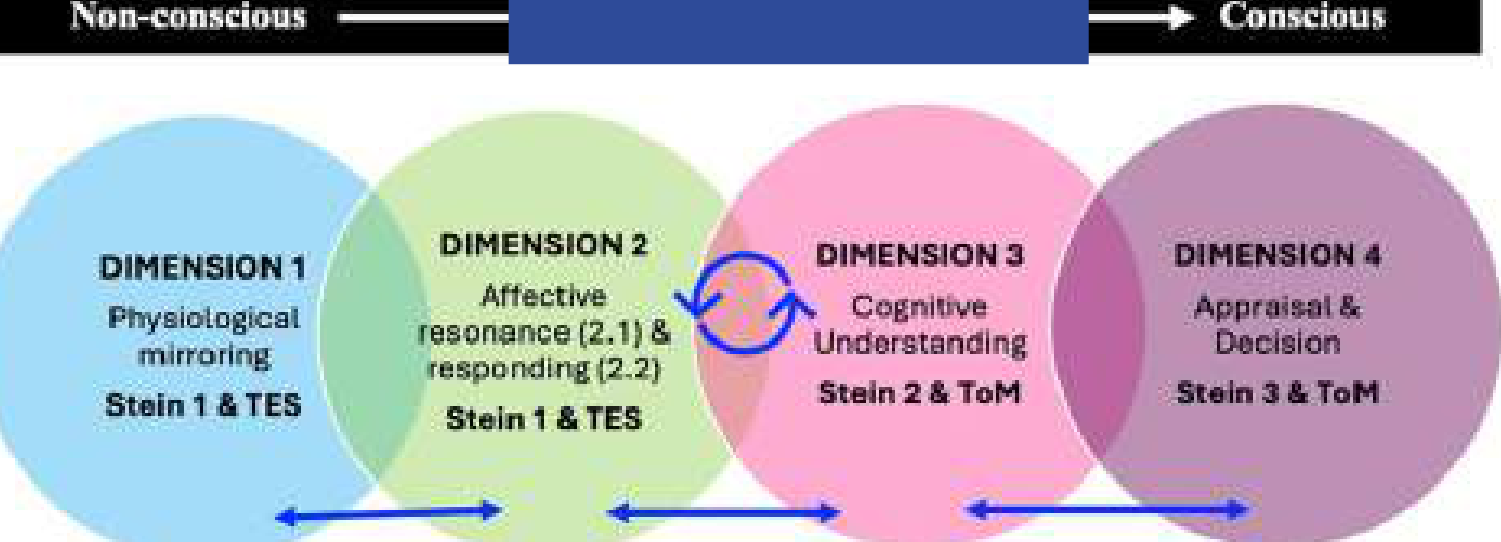
Interestingly, a recent integrative framework published in Frontiers in Human Neuroscience articulates this very sequence as a unified perceptual process: from physiological mirroring, to affective resonance and response, to cognitive understanding, and finally to evaluation and decision-making [4]. This research proposes that empathy be regarded not as a subjective moral virtue, but as a measurable social-perceptual process—exactly the pathway traced in the brain of that helping individual.
Stop Four: The reward the brain gives for helping
The final stop is where decision transforms into action—and the brain rewards this choice. The moment someone reaches out to help, dopaminergic reward pathways (the ventral tegmental area and nucleus accumbens) are activated—the same circuitry that lights up with success or pleasure. Simultaneously, the hypothalamus releases oxytocin, a hormone that not only strengthens feelings of connection but also binds directly to receptors in the helper’s own amygdala, reducing their anxiety and cortisol levels [3]. Simply put: helping another, biologically speaking, heals the helper as well.
A Horizon for the Future: Is empathy teachable?
These findings raise an important practical question: if empathy follows a four-stage, mappable pathway in the brain, can it be enhanced or even rehabilitated? Recent reviews suggest that efforts involving pharmacological treatments, brain stimulation, and behavioral interventions to enhance or restore empathic function are beginning to emerge, although the effect sizes of these interventions remain moderate and context-dependent [5]. Although this field is still in its infancy, it opens up a promising horizon: perhaps in the future, strengthening empathy circuits could evolve from an ethical aspiration into a genuine clinical target.
References
- Lamm, C., Decety, J., & Singer, T. (2011). Meta-analytic evidence for common and distinct neural networks in the perception of pain in self and in others. NeuroImage, 54(3), 2492-2502.
- Preston, S. D., & de Waal, F. B. (2002). Empathy: Its ultimate and proximate bases. Behavioral and Brain Sciences, 25(1), 1-20.
- Eckstein, M., Becker, B., Scheele, D., Scholz, C., Weber, K., Kendrick, K. M., & Hurlemann, R. (2015). Oxytocin facilitates the extinction of conditioned fear in humans. Biological Psychiatry, 78(3), 219-227.
- Irish, K. K. (2026). A transdisciplinary framework for empathy research. Frontiers in Human Neuroscience, 20, 1703147.
- Dines, J. T., & Niazi, S. K. (2026). Therapeutic modulation of empathy: pharmacological, neurostimulation, and behavioral approaches. Frontiers in Psychology, 17, 1762816.